


Knowledge about how a chromatography column is packed and unpacked rarely sits in one place. Part of it lives in operating procedures. Part of it lives in equipment manuals. A large part lives in the daily experience of the operators who run the process. When you prepare to specify a new column, this combined knowledge becomes useful design input for Peak Biotech. Describing the full packing and unpacking workflow helps us understand how the operators work and provides a clearer basis for configuring the supporting equipment, access and layout. It also helps us assess how the equipment can be configured with the aim of making handling easier and operation safer.
The Procedure Begins with Media Handling
Chromatography media form the separation bed inside the column. Before Peak Biotech can configure the equipment, we need to understand how your media arrives and how it is handled at your site.
The media may arrive dry, pre-wetted or in another form. It may be supplied in drums, buckets, cans, bags or other containers. The delivery form affects how the media is opened, handled and added to the slurry unit. Dry media needs wetting and mixing before use, while pre-wetted media is handled differently.
The total media volume is a central input. It defines how much material must be moved and prepared for one column filling. Together with the required total slurry volume, it contributes to the sizing of the slurry unit. How the media is moved from the delivery container also matters. Small volumes may be emptied by hand, while larger volumes may need lifting equipment or a hoist. Peak Biotech uses this information to understand which handling equipment and access conditions your procedure requires.
Slurry Preparation Affects the Supporting Equipment
The slurry unit holds and mixes the media in buffer before transfer to the column. How the slurry is prepared has a direct effect on the supporting equipment.
Peak Biotech needs to understand where your slurry is prepared and how much slurry one column filling requires. The total slurry volume is a key input when configuring the slurry unit. The way the media and buffer are added affects the connections and the working sequence at the slurry unit.
Keeping the slurry homogeneous is an important function. If slurry homogeneity is not maintained, the solids concentration may vary during transfer to the column. The required mixing principle depends on the media behaviour, slurry volume and handling procedure. Some slurry units use a top mixer, while rotating slurry units may be used for silica-based resins in HPLC chromatography. The position of the slurry unit in relation to the column is another practical input. Peak Biotech uses this information to advise on the slurry unit and the transfer equipment. The advice depends on the process information you provide.
The Packing Area Defines the Equipment Requirements
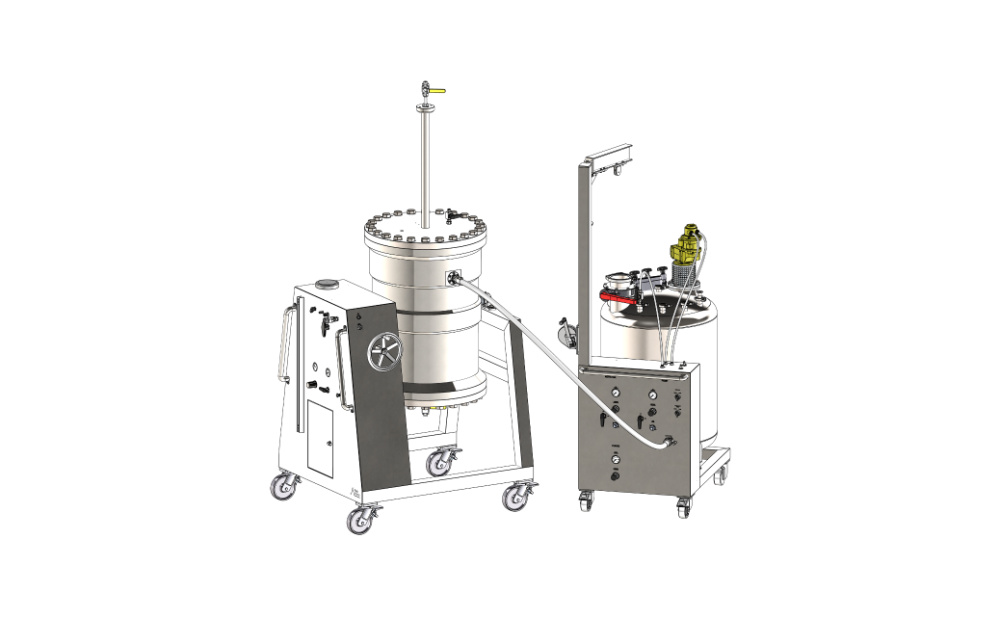
The slurry has to travel from the slurry unit into the column. The transfer path is the physical route this suspension follows. Peak Biotech aims to keep this route as short as possible. Its configuration depends on the transfer distance, hose routing, sanitary connections, equipment positions and available access.
Peak Biotech needs to understand where the slurry unit can be positioned in relation to the column, because this determines the required hose length, hose routing and operator access to the connections.
The classification of the packing area is also important. Packing in an ATEX classified area means the equipment must meet the relevant explosion protection requirements. This affects electrical components, the pump, the mixer and instrumentation, so it is important to describe the area classification early.
Column Preparation is Part of the Packing Workflow
The column is prepared before any slurry enters it. All Peak Biotech columns use dynamic axial compression, or DAC. The piston forms and compresses the bed and maintains the defined axial compression during operation. The column includes a process side and a separate hydraulic compression side.
On the process side, the column is primed with buffer or solvent before slurry is introduced. The slurry filling method depends on the column size. Larger columns include a slurry inlet valve, so the slurry enters through a defined connection. Buffer leaves through the process inlet or outlet valves. For small HPLC columns, filling is performed with the column bottom removed instead of through a slurry inlet valve. The slurry is introduced through the open bottom.
On the hydraulic side, the compression chamber contains 20% ethanol in water and does not use hydraulic oil. During packing, this fluid drives the piston downward and maintains the packing pressure. These functions are defined by the column design.
Packing Completion is Determined from Packing Pressure and Piston Position
During packing, the piston moves downward and the bed forms under compression. The packed bed inside a stainless-steel column cannot be seen directly. Instead, piston position gives the bed height reference, and the packing pressure is read on the column. Packing pressure and piston position provide the references used to determine packing completion according to the defined procedure. Packed bed efficiency is evaluated separately through column performance testing, using parameters such as HETP. Peak Biotech supplies the equipment and its operating range. Peak Biotech does not define your packing parameters.
Unpacking Behaviour Changes the Column Configuration
Unpacking has to be understood before the final hardware configuration is completed. The way a column is emptied affects several parts of the equipment.
The most important input is how the media or resin behaves when it is removed. Some media used in low and medium pressure chromatography can be re-suspended in buffer and removed through a slurry outlet valve. In HPLC chromatography, some resins form a compact cake under pressure. The cake is pressed out after the column bottom has been removed. These two behaviours require different unpacking arrangements and affect the column configuration, so Peak Biotech needs to know which one applies.
The unpacking method therefore affects the slurry outlet arrangement, available working space, lifting equipment, handling of the column bottom and collection of the removed media or resin.
Peak Biotech HPLC columns can be rotated, so the column bottom is accessible as part of the column design. For larger columns, the bottom may be too heavy to remove and handle manually. The unpacking arrangement may therefore require a crane, lifting frame or other dedicated lifting equipment. The required arrangement is assessed against the bottom weight, available lifting height and lifting capacity. It also depends on access around the column and how the bottom is moved and placed during unpacking. The working space required for cake removal, resin collection and operator access is assessed as well.
The removed media or resin may be collected for recovery or sent for disposal. Understanding unpacking early helps configure the arrangement for better access and easier handling, with safer operation as a design objective.
The Current Workflow Adds Practical Design Information
The current production area often reveals practical information that is not captured in formal documentation. Peak Biotech can identify this information in several ways. Operator interviews describe how the work is actually done. Observation of the current procedure shows the real movements and handling steps. Reviewing the existing equipment and production area shows the interfaces in use, available space, equipment positions and access conditions.
A site visit brings these observations together. It helps Peak Biotech understand your existing workflow, the equipment interfaces and the access conditions. We treat site visits and technical workshops as collaborative design activities with you. The purpose is to understand your workflow, not to audit or correct it. Reviewing the current setup together helps show how new equipment can support your work.
Equipment is Configured for Each Project
Peak Biotech has worked with many column sizes, media handling methods and process area layouts. Each column and its supporting equipment are configured for the individual project rather than fixed to one standard. When a requirement differs from earlier projects, we develop the configuration around your process, facility requirements, operator access and intended workflow.
Understanding the Procedure Helps Shape the Equipment Solution
Project specific packing and unpacking information helps Peak Biotech configure the slurry handling equipment, equipment placement, access, interfaces and unpacking arrangements around your process area. The objective is to provide relevant access, suitable functions and sensible equipment placement for the intended workflow. Where the scope allows, the configuration may reduce manual handling steps, improve operator access or contribute to safer operation. These are design objectives that depend on the agreed scope and your requirements.
Peak Biotech uses the project specific parts of your established or planned workflow as design input. Peak Biotech does not define your packing procedure. The packing procedure and acceptance criteria remain the responsibility of the process owner. Understanding your packing and unpacking workflow provides the design input needed to configure the relevant equipment around your process and facility.
Questions to Help Describe Your Packing and Unpacking Workflow
A clear description of the packing and unpacking workflow gives a stronger basis for discussing a new column project.
Download the question guide to prepare information about media or resin handling, slurry preparation, equipment placement, operator access, unpacking behaviour and lifting requirements.
Questions on your own scale-up? Ask an engineer.