

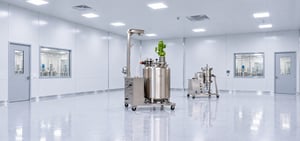
Chromatography Handling and Support Equipment
The equipment that moves, fills and maintains the column, engineered as part of the same project.
Supporting the Complete Chromatography Workflow
A production chromatography column is only one part of the operating setup around it. Slurry has to be prepared and transferred, the column may need to be positioned or moved for packing, cleaning or maintenance, and components have to be accessed safely once the column is in service.
Peak Biotech specifies the handling and support equipment for this workflow alongside the column itself. The configuration is defined by column size, chromatography media, facility layout and how the column will actually be operated and maintained over its production life.
The Equipment around the Column
Specifying a column is not only a question of diameter and pressure rating. Slurry preparation, column movement, maintenance access and component handling all affect how the column is prepared, operated and maintained over years of production. These considerations should be defined together with the column configuration so the operating and maintenance workflow is understood before installation.
Three Primary Solution Areas
A visually scannable overview directly below the intro, three tiles giving the reader an immediate map of the page's core content.
| Area | What it covers |
| Slurry support equipment | Equipment for slurry preparation, mixing and transfer before column filling and packing, selected for media type and volume. |
| Column movement | Movement concepts for HPLC, MPLC and LPLC columns, including lockable wheels and dedicated forklift compatible handling. |
| Maintenance and service access | Controlled access to heavy or product contacted components for frit, piston, seal and distributor work over the column's working life. |
Additional equipment for wider project scope, such as buffer tanks or CIP and SIP units, is covered separately further down the page.
Why Slurry Behaviour Matters
How resin and buffer behave in suspension affects how consistently the slurry transfers into the column. Heavy silica based particles can settle relatively quickly once agitation stops. Softer chromatography media generally stay suspended longer and are more sensitive to shear. The two behaviours call for different equipment. How resin and buffer behave in suspension affects how consistently the slurry transfers into the column. Heavy silica based particles can settle relatively quickly once agitation stops. Softer chromatography media generally stay suspended longer and are more sensitive to shear. The two behaviours call for different equipment.
Rotating Slurry Unit
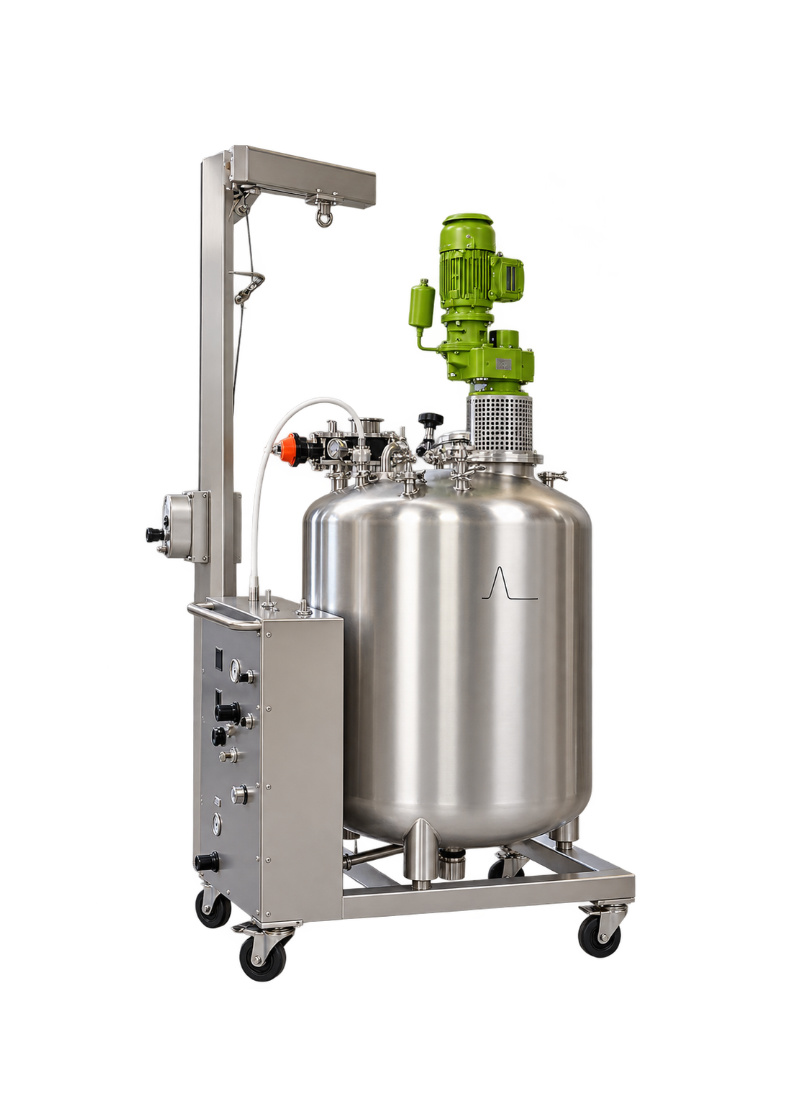
For HPLC applications using relatively heavy silica based media, Peak Biotech supplies a rotating slurry unit. The complete vessel rotates, keeping resin and slurry buffer in motion without a mechanical agitator working inside the vessel. This reduces the opportunity for heavy particles to settle below or around an agitator shaft and helps maintain a homogeneous slurry through preparation and transfer. Rotating units are available up to approximately 150 L.
Standing Slurry Unit
For larger slurry volumes, normally above approximately 150 L, and for softer media, Peak Biotech supplies a standing slurry unit. The vessel is stationary and can use a suitable top mixer, giving gentler handling appropriate to media that is more sensitive to mechanical shear.
Selection and Role in the Process
Slurry unit selection follows media type and volume rather than column size alone. The equipment supports slurry condition and transfer into the column. Final packed bed performance also depends on the media itself, slurry concentration, the packing procedure, operating parameters and how the pack is executed.
The same slurry unit may also form part of the unpacking or resin recovery concept. Whether it does depends on media reuse, unit geometry, column size, available space and your procedure. This is defined per project rather than following one fixed method.
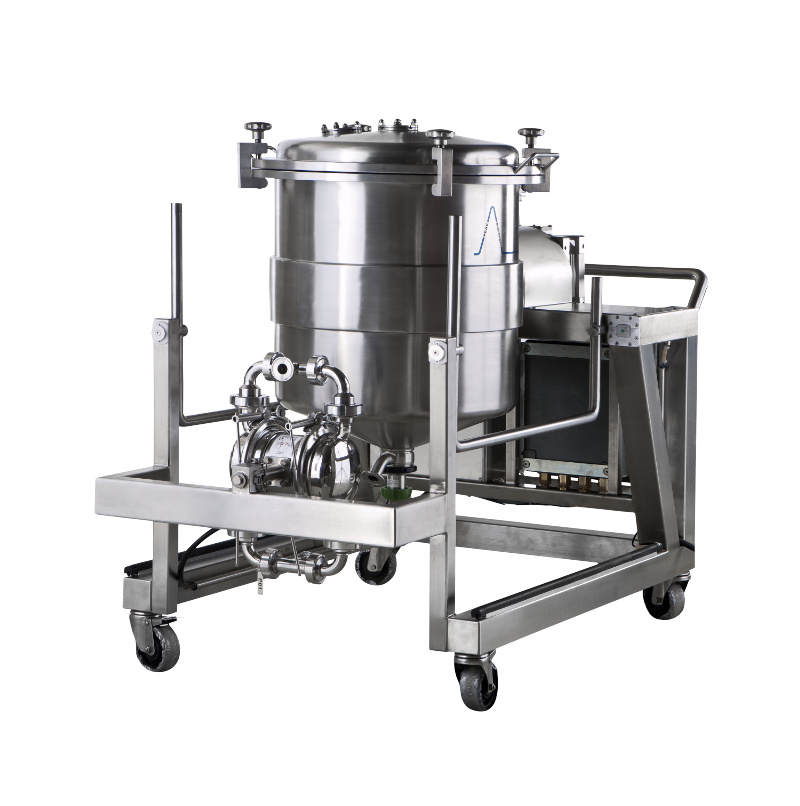
Comparison
Additional equipment for wider project scope, such as buffer tanks or CIP and SIP units, is covered separately further down the page.
| Configuration | Typical use | Mixing principle | Key consideration |
| Rotating slurry unit | HPLC applications with heavier silica based media, up to approximately 150 L | Complete vessel rotates | Reduces settling of heavy particles, supports a homogeneous slurry |
| Standing slurry unit | Larger volumes, normally above approximately 150 L, and softer media | Stationary vessel with a suitable top mixer | Gentler handling for shear sensitive media |
Column Movement
Planning how a production column is moved or repositioned should form part of facility design and operating planning from the beginning.
Peak Biotech HPLC columns up to Ø800 mm can be designed with lockable wheels, without fixed floor installation as standard. This supports planned repositioning for cleaning, maintenance access or process changeover according to site procedures.
Peak Biotech MPLC and LPLC columns can also be moved. For these columns, dedicated forklift compatible handling equipment can be used for planned movement and positioning within the facility.
The movement concept is defined according to column type, size and weight, facility layout, floor condition, cleanroom procedure and the handling equipment available on site. This allows the appropriate movement method to be planned together with the column and facility interface.
For HPLC configurations this means a mobile frame with lockable wheels. For MPLC and LPLC configurations it means dedicated forklift compatible handling equipment or suitable customer site equipment.
Maintenance and Service Access
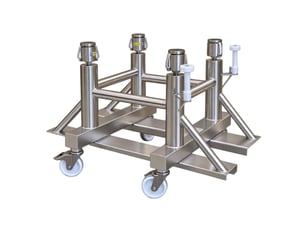
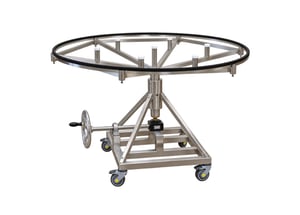
Moving the complete column and handling individual components during maintenance are different engineering tasks. As column components grow larger and heavier, frit access, distributor access, seal and O ring replacement, bottom handling, piston handling and heavy component lifting all need a controlled, repeatable approach.
1. Bottom handling
Supports controlled removal, lowering, support and positioning of large column bottom assemblies during scheduled maintenance2. Rotation stand
Supports controlled rotation of the column bottom during scheduled maintenance, giving access to seals, frits and distributor components without full disassembly3. Frit and distributor handling
Supports handling of large frit assemblies when their diameter and weight make manual handling inappropriate, together with access to distributor components during service4. Piston and assembly support
Supports piston related service activities, including access to seals, frits and distributors, together with assembly and reassembly during scheduled maintenance.Lifting and handling solutions and project specific maintenance tool sets support these areas.
5. Project specific maintenance tool sets
Project specific tool sets can support disassembly, frit and distributor access, seal replacement and reassembly. Scope is defined per project rather than supplied as one fixed catalogue of hand tools6. Frit maintenance
The frit is a functional product contacted component. It retains chromatography media and forms part of the liquid path into and out of the packed bed. A blocked or partially blocked frit can influence hydraulic response.During scheduled maintenance, frit assemblies can be inspected, cleaned and reused when condition and your maintenance procedure allow it. Replacement is carried out when inspection, cleaning result or your procedure requires it
Cleanability comparison
|
Design feature |
Peak Biotech column |
|
Hydraulic system |
Internal |
|
Hydraulic fluid exposure |
No external fluid lines |
|
External components |
Minimal |
|
Surface geometry |
Smooth |
|
Cleaning access |
Easy wipe down |
|
Risk of residues |
Very low |
Additional Equipment when the Project Requires It
Additional process equipment can be included selectively where it supports the defined chromatography project.
Engineered around the Operating Workflow
A production column moves through a defined sequence over its working life: column movement, slurry preparation, column filling, packing setup, piston movement, bed compression, unpacking, media recovery or waste handling, frit and distributor access, cleaning, seal replacement, reassembly, spare parts and operator training. Equipment selection should reflect the complete operating sequence around the column.
-
Decision factors
-
Column size
-
Chromatography media
-
Packing and unpacking procedure
-
Facility layout
-
Maintenance procedure
Peak Biotech columns can be specified with the slurry support equipment, movement concept and maintenance setup required around the actual operating workflow. The configuration is defined according to column size, chromatography media, facility layout and your site procedures.
Lifecycle Support
Support equipment is one part of a longer relationship. Spare parts, qualification documentation, operator training and on site assistance continue after installation and are covered under our wider lifecycle support.

