


Scaling a chromatography column from development scale to production scale changes more than the physical dimensions of the equipment.
As column diameter increases, the wall represents a smaller proportion of the packed bed. At the same time, liquid must be distributed across a much larger cross section, and local differences in the bed can become more relevant to the overall flow pattern.
This creates an important distinction.
Wall effects do not simply become larger as the column becomes larger. Their relative geometric influence decreases. What changes is how they interact with packing quality, radial flow distribution and the larger production system.
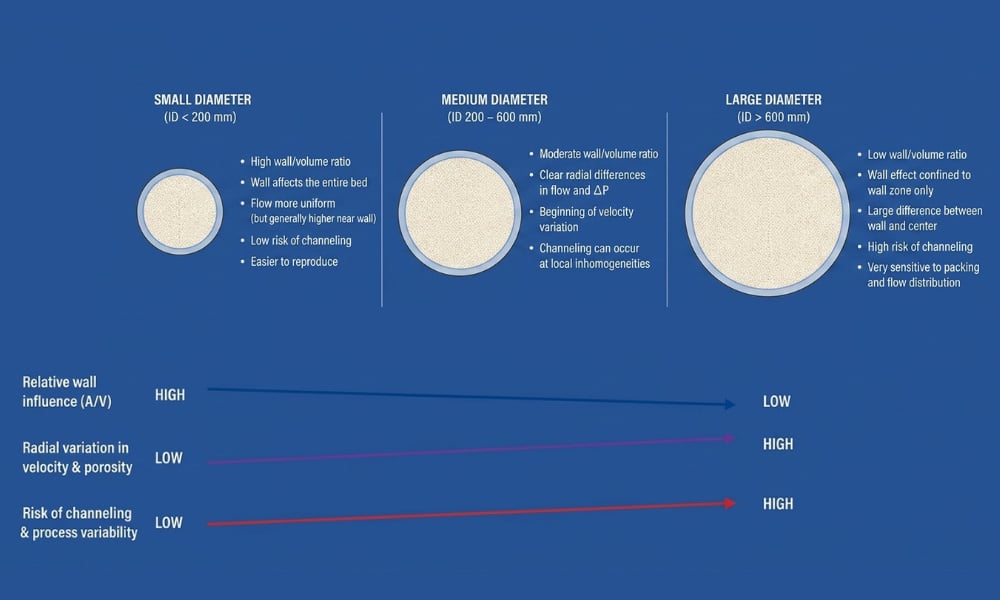
Small Diameter: High Relative Wall Influence
In a small diameter column, a relatively large proportion of the packed bed is located close to the column wall.
Particles next to a solid boundary cannot arrange in exactly the same way as particles within the bulk of the bed. This creates a wall region with somewhat different packing structure and permeability.
Because the distance from the wall to the centre of the column is small, this wall region represents a comparatively large part of the bed.
At the same time, the total cross sectional area is small. Liquid is distributed across a shorter radial distance, and the volumetric flow required at a given linear velocity is relatively low.
The result is slightly counterintuitive.
The wall has a relatively high geometric influence, but the overall flow system can still be easier to reproduce because the distances and flow volumes involved are smaller.
As Diameter Increases, Radial Differences Matter Differently
Increasing column diameter reduces the relative proportion of the bed affected directly by the wall.
The wall to volume ratio falls.
This does not mean that radial behaviour becomes irrelevant. The opposite can occur from an operational perspective.
A larger column introduces liquid across a wider cross section. At the same linear velocity, the required volumetric flow increases because column area increases with the square of the diameter. The distributor and packed bed therefore have to establish consistent flow conditions over a much larger area.
Peak Biotech's scale up review describes this distinction clearly. The basic column design principle can remain the same as diameter increases, while the required volumetric flow and the demands placed on flow distribution increase substantially. The distribution plate is dimensioned to distribute incoming liquid across the full column diameter, while the packed bed itself provides hydraulic resistance that also contributes to the resulting flow distribution.
This is the point where local differences in packing begin to matter in a different way.
A packed bed is never perfectly identical at every radial position. Small differences in packing structure, permeability or hydraulic resistance can influence where liquid preferentially moves.
At intermediate diameters, these differences may become more visible as radial variation in velocity and pressure response.
They do not automatically create channeling. But if local inhomogeneities are present, the larger cross section gives those differences more opportunity to influence the overall flow pattern.
Large Diameter: A Smaller Wall Region Inside a Larger System
At large production diameters, only a small proportion of the total packed bed is located directly within the wall region.
Geometrically, the influence of the wall has decreased.
But the distance between the wall and the centre of the column has increased substantially.
The engineering question therefore changes.
It is no longer primarily about how much of the packed bed is affected by the wall. It is about whether sufficiently consistent hydraulic conditions can be maintained from the centre of the column to its outer region.
Packing quality becomes important because local differences in the packed bed can alter hydraulic resistance. Flow distribution becomes important because liquid must be introduced and collected consistently across the complete diameter.
The interaction between the two matters more than either factor considered alone.
This is also why channeling should not be treated simply as an inevitable consequence of increasing diameter. Peak Biotech's technical review notes that wall related effects are generally small and that differences observed between column sizes are often more closely associated with packing quality or operating conditions.
Large diameter therefore does not necessarily mean poor distribution.
It means that good packing and good distribution have to work together across a much larger cross section.
What this Changes in Column Design
This distinction matters when production columns are designed.
The distributor must introduce liquid across the full cross section rather than relying on the bed to correct significant differences after the liquid enters.
The packed bed must provide sufficiently consistent hydraulic resistance across that area.
Packing procedures must create a homogeneous bed, because local differences in slurry preparation, packing pressure or packing execution can influence the final bed structure. Peak Biotech's operating experience also points to slurry preparation and packing procedure as major contributors when differences are observed between otherwise comparable columns.
These factors are connected.
Distributor design defines the conditions entering the bed. Packing defines the hydraulic structure through which the liquid then flows. The wall introduces a local boundary condition that remains present regardless of diameter.
As scale increases, considering these elements together becomes more important than looking at the wall effect in isolation.
The Important Change is not Size Alone
At larger diameters, wall effects have not disappeared.
Nor have they simply become larger.
Their relative geometric contribution becomes smaller while the system around them becomes larger and more dependent on consistent packing and flow distribution.
That is the scale up transition that matters.
The role of the wall changes because the relationship between the wall, packed bed and overall flow field changes with it.
For the technical mechanism behind why this happens, see Why Wall Effects Occur in Packed Chromatography Columns.
Questions on your own scale-up? Ask an engineer.
Sources
A.G. Dixon, Correlations for Wall and Particle Shape Effects on Fixed Bed Bulk Voidage, Canadian Journal of Chemical Engineering, 1988. DOI
N. Wakao and T. Funazkri, Effect of Fluid Dispersion Coefficients on Particle to Fluid Mass Transfer Coefficients in Packed Beds, Chemical Engineering Science, 1978. DOI