

Chromatography Column Scale-Up is not Just a Linear Process
Scaling up chromatography columns is often treated as a continuation of process development. A purification process is developed at laboratory scale, where separation performance and resolution are demonstrated under controlled conditions.
At this stage, performance appears robust and reproducible. Column packing is often performed under controlled conditions, sometimes supplied packed by the supplier, and flow distribution and pressure profiles are stable due to the small scale.
During scale-up, the challenge is not an expectation of identical performance, but the underestimation of how strongly key parameters change with scale. Increasing column diameter while maintaining linear velocity is, in principle, sufficient. In practice, it is not.
At larger scale, the chromatography column defines the mechanical and operational conditions under which the process must run, while the packed bed defines the separation performance. Changes in column size alter flow distribution, pressure behaviour, and packing conditions, introducing variability that is not present at laboratory scale.
As a result, performance at small scale is often a reflection of controlled conditions rather than a fully understood or robust process. This does not translate directly to industrial scale, where performance depends on the ability to control packing, flow, and pressure under fundamentally different conditions.
Variability Increases at Production Scale
What defines performance in chromatography?
In large scale process chromatography, it is important to distinguish between the column hardware, the packed bed, and the system.
The column hardware defines the mechanical and operating conditions, such as pressure capability, geometry, and flow distribution.
The packed bed defines the separation performance, including efficiency and resolution, and plays a central role in reproducibility.
The system refers to the equipment used to drive and control the column, including pumps for the mobile phase/ buffers, valves, and the control system.
While these elements are often discussed together, it is their interaction that determines performance at scale.
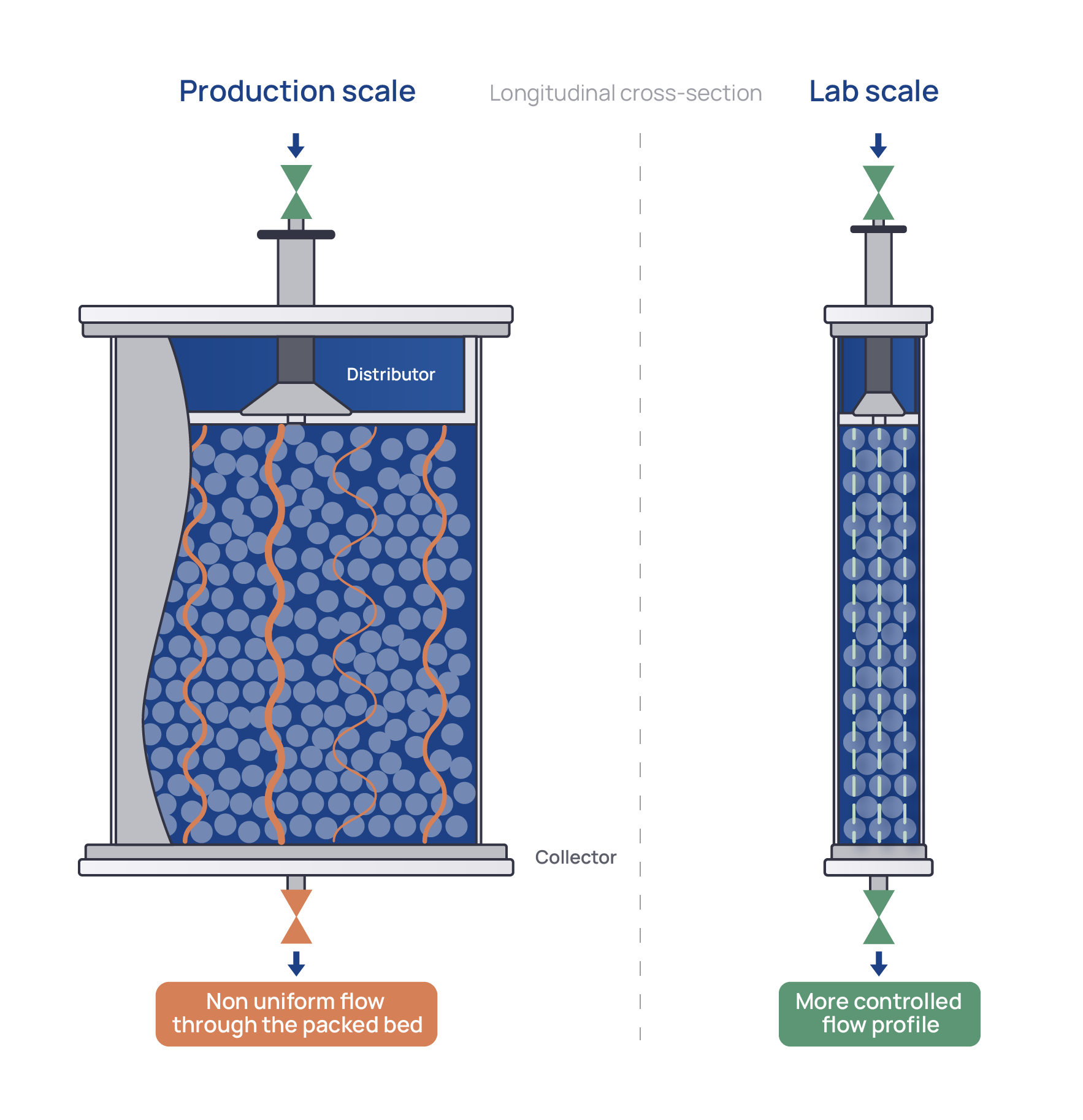
As chromatography moves from small scale to large scale chromatography, the column–system interaction becomes increasingly important. The columns cross-sectional area increases significantly when scaling and maintaining uniform distribution of the mobile phase/ buffers across the packed bed becomes more challenging.
- Flow rates that appear stable at laboratory scale interact differently with column diameter at industrial scale
- Linear velocity is no longer sufficient as a single scaling parameter, as pressure, flow, and residence time become interdependent
- Distribution of the mobile phase/ buffers are often blamed for bad column performance, but even small deviations in packing can lead to channeling, reduced column efficiency, and loss of separation
These are not theoretical effects they are structural challenges that emerge as column scale increases.
At this stage, the effectiveness of the purification process is defined by how well the column and system can maintain stable conditions across the entire packed bed.
Column Packing Becomes a Defining Variable at Industrial Scale
Column packing is an underestimated factor in chromatography column scale up. During process development, packing is often treated as a repeatable method using a defined packing material, with procedures that can be transferred across scales.
However, as column diameter increases, the impact of packing variability becomes more pronounced. Axial compression, slurry handling, and execution, including differences between operators, introduce variability in how well bed is packed and a less optimal packed bed is directly affecting the chromatographic performance.
A packed bed that appears uniform at small scale may not maintain the same consistency in a large-scale column. Small deviations in packing can lead to changes in flow distribution, which in turn affect separation efficiency and resolution. These effects have less impact during process development under controlled conditions but become significant during manufacturing.
At industrial scale, column packing is not simply a step in the process it is a critical variable that determines whether performance can be maintained.
Process Development Optimizes for Performance, Not for Manufacturing Reality
Process development is typically focused on optimizing key parameters such as separation efficiency, peak resolution, and concentration profiles. Data is generated to determine optimal conditions, and the method is refined to achieve the best possible chromatographic performance.
However, these optimizations are often carried out under conditions that do not reflect production scale.
At full scale production, additional factors become dominant. Flow must be maintained across a large cross-sectional area, pressure must remain within acceptable limits, and the process must be reproducible across batches. Regulatory standards require validation of consistency, not just performance in a single run.
A method that performs well under controlled conditions may not be robust enough for manufacturing.
This creates a disconnect between process development and production.
The Chromatography Column Defines the Operating Conditions of the Process
At laboratory scale, it is easy to assume that the packed bed defines separation. In reality, at industrial scale, the chromatography column defines the mechanical and operational conditions under which the process can run.
Flow distribution, pressure control, and the ability to maintain a stable environment across the bed are all determined by the column design. The packed bed delivers separation, but only within the parameters set by the column.
This leads to a critical principle:
Column design defines parameters like flow distribution, working pressure range, and operating conditions while the packed bed delivers the separation performance within these parameters.
If the column cannot maintain uniform flow, stable pressure, and reproducible packing, then the separation observed at small scale cannot be reproduced at large scale, regardless of the method.
At this point, the column is no longer a passive component. It becomes a central part of the process design.
Successful Scale-Up Requires Designing for Industrial Scale Conditions
Successful scale-up is not achieved by transferring a method from laboratory scale to production. It requires designing both the column and the system for industrial conditions from the beginning.
This includes understanding how parameters such as flow, pressure, column length, and diameter interact within the column, and how these factors influence chromatographic performance.
It requires consistent packed bed formation, controlled variability within the column, and stable, reproducible operation of both the column and system over time.
Automation can support consistency, but it cannot compensate for a column that cannot maintain stable conditions or a system that cannot operate it consistently.
Key considerations for successful scale-up include not only separation performance, but also robustness of the packed bed, and the ability of both the column and the system to operate reliably under manufacturing conditions.
Key Takeaway: Scale-Up Failure is a Design Issue, Not a Process Issue
So, scaling up chromatography columns does not fail because separation chemistry changes. It fails because the process is not designed to operate under the conditions of large-scale production.
A purification process that performs well at laboratory scale but cannot be maintained at industrial scale is not robust. It is not optimized for manufacturing.
Performance must be evaluated not only based on data generated during process development, but on the ability to maintain that performance across batches, operators, and time.
If this cannot be achieved, the process cannot be used for reliable manufacturing.
Point of View: Chromatographic Performance is Defined by the Process Environment
In process chromatography, performance is often attributed to the method, the choice of packing material, mobile phase/ buffer, and defined parameters.
At large scale, this perspective is insufficient.
Chromatographic performance is defined by the interaction between the column, the packed bed, and the system in which it operates. Together, they determine whether the required conditions can be achieved and maintained.
This shifts the focus from method optimization to process design.
Because at industrial scale, the question is no longer whether separation can be achieved, but whether it can be maintained consistently in commercial production.
Questions on your own scale-up? Ask an engineer.